System Architecture
This document provides a comprehensive overview of the Tracker System architecture, including all components, containers, and their connectivity.
Architecture Overview
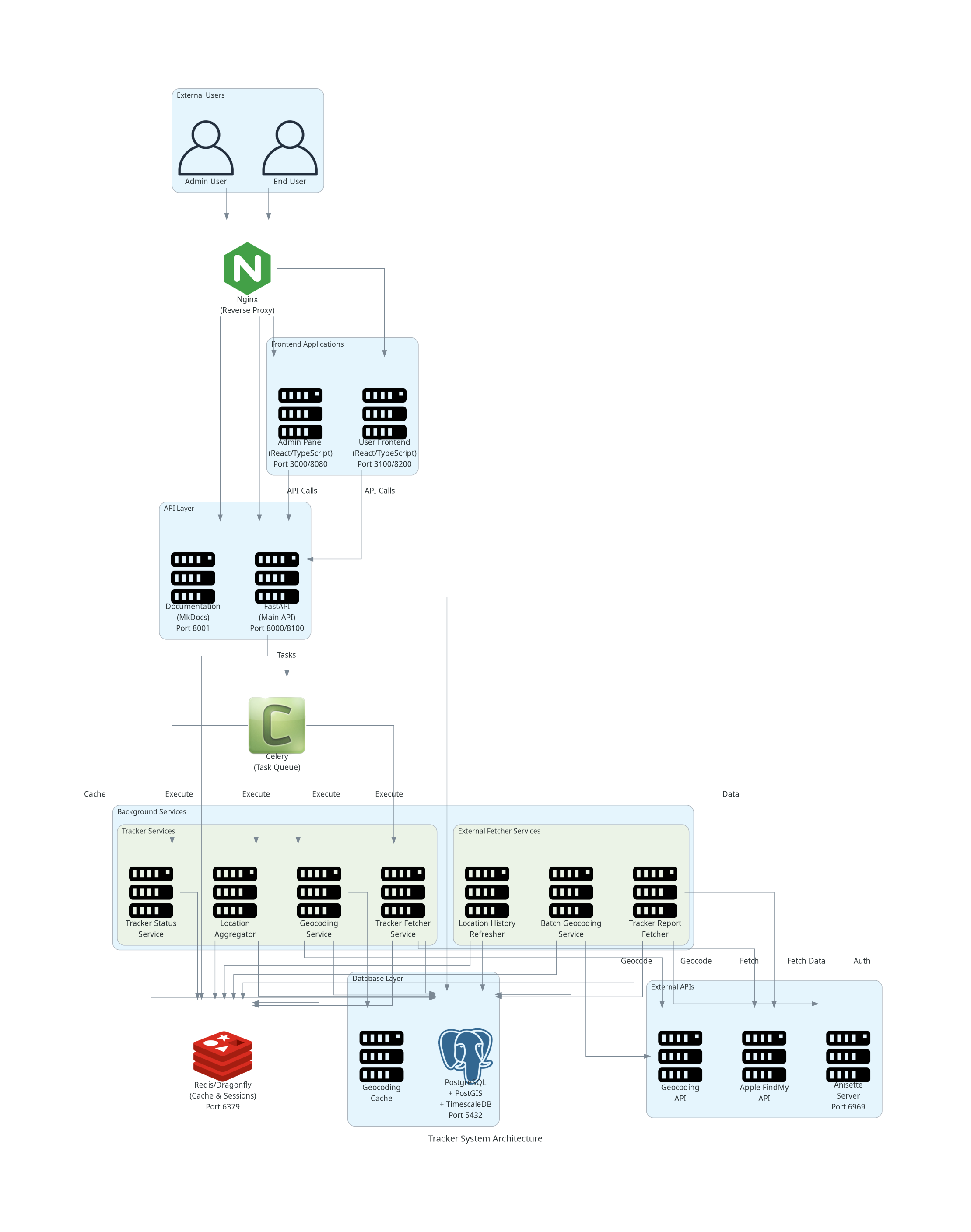
The Tracker System is a distributed application built with a microservices architecture, consisting of multiple frontend applications, a REST API, background services, and supporting infrastructure components.
System Components
Frontend Applications
Admin Panel
- Technology: React with TypeScript and Tailwind CSS
- Ports: 3000 (development), 8080 (production)
- Purpose: Administrative interface for managing clients, brands, production runs, trackers, and locations
- Features:
- User management with role-based access control
- Interactive maps for location management
- Dashboard with system statistics
- Dark mode support
User Frontend
- Technology: React with TypeScript and Tailwind CSS
- Ports: 3100 (development), 8200 (production)
- Purpose: End-user interface for viewing tracker information
- Features:
- Tracker status and location viewing
- Image gallery
- Responsive design with dark mode
API Layer
FastAPI (Main API)
- Technology: FastAPI with Python
- Ports: 8000 (production), 8100 (development)
- Purpose: Core REST API providing all backend functionality
- Features:
- JWT-based authentication with role-based access control
- OpenAPI/Swagger documentation
- Client filtering and multi-tenancy
- Performance monitoring and caching
- CORS handling
Documentation Service
- Technology: MkDocs with Material theme
- Port: 8001
- Purpose: Serves comprehensive system documentation
- Features:
- API reference documentation
- User guides and tutorials
- Architecture documentation
Background Services
Tracker Services (Internal)
These services run as TaskiQ tasks within the main application:
- Tracker Fetcher Service: Fetches tracker data from external APIs
- Tracker Status Service: Processes tracker status updates and geofencing
- Location Aggregator: Aggregates location data using TimescaleDB continuous aggregates
- Geocoding Service: Handles address geocoding and reverse geocoding
External Fetcher Services
These services run as separate containers in the fetcher deployment:
- Location History Refresher: Refreshes historical location data
- Tracker Report Fetcher: Fetches tracker reports from Apple FindMy API
- Batch Geocoding Service: Processes geocoding requests in batches
Infrastructure Components
Database Layer
PostgreSQL with Extensions
- Port: 5432
- Extensions: PostGIS, TimescaleDB
- Purpose: Primary data storage
- Features:
- Geospatial data support with PostGIS
- Time-series data optimization with TimescaleDB
- Continuous aggregates for performance
- Full-text search capabilities
Geocoding Cache
- Purpose: Caches geocoding results to reduce API calls
- Implementation: Database table with efficient indexing
Cache Layer
Redis/Dragonfly
- Port: 6379
- Purpose: Caching and session storage
- Features:
- API response caching
- Session management
- Task queue backend for TaskiQ
- Performance optimization
Message Queue
TaskiQ
- Purpose: Asynchronous task processing
- Backend: Redis/Dragonfly
- Features:
- Background task execution
- Scheduled tasks
- Task monitoring and retry logic
External Services
Apple FindMy API
- Purpose: Source of tracker location data
- Authentication: Via Anisette server
Anisette Server
- Deployment: AWS ECS container
- Purpose: Provides authentication tokens for Apple services
- Access: Internal service endpoint
Geocoding API
- Purpose: Converts addresses to coordinates and vice versa
- Usage: Batch processing and real-time geocoding
Data Flow
User Interactions
- Admin Users access the Admin Panel through load balancer (AWS ELB in production, Nginx in development)
- End Users access the User Frontend through load balancer (AWS ELB in production, Nginx in development)
- Both frontends communicate with the FastAPI backend via REST API calls
API Processing
- Authentication: JWT tokens validate user access
- Client Filtering: Multi-tenant data isolation
- Caching: Redis provides fast response times
- Database Operations: PostgreSQL handles data persistence
Background Processing
- Task Queuing: TaskiQ manages asynchronous tasks
- Data Fetching: Services retrieve data from external APIs
- Data Processing: Location aggregation and status updates
- Geocoding: Address resolution and caching
Deployment Architecture
Development Environment
- Profiles:
devprofile in Docker Compose - Hot Reload: Volume mounts enable live code updates
- Debug Support: Debug ports exposed for development tools
Production Environment
- Profiles:
prodprofile in Docker Compose - Optimization: Built containers with production optimizations
- Scaling: Services can be scaled independently
Container Orchestration
- Docker Compose: Manages all services and dependencies
- Networks: Isolated network for service communication
- Volumes: Persistent storage for database and cache data
Security Architecture
Authentication & Authorization
- JWT Tokens: Secure API access
- Role-Based Access Control: Different permission levels
- Session Management: Redis-backed sessions
Network Security
- Load Balancer: AWS ELB in production, Nginx in development handles external traffic
- Internal Networks: Services communicate on isolated networks
- Port Isolation: Only necessary ports exposed externally
Data Security
- Database Encryption: Sensitive data protection
- API Key Management: Secure external service authentication
- CORS Configuration: Controlled cross-origin access
Performance Optimization
Caching Strategy
- Multi-Level Caching: Redis for API responses and sessions
- Database Optimization: TimescaleDB for time-series data
- Geocoding Cache: Reduces external API calls
Database Performance
- Continuous Aggregates: Pre-computed time-series summaries
- Spatial Indexing: PostGIS indexes for location queries
- Connection Pooling: Efficient database connections
Monitoring & Observability
- Performance Metrics: Built-in performance monitoring
- Logging: Comprehensive application logging
- Health Checks: Service availability monitoring
Scalability Considerations
Horizontal Scaling
- Stateless Services: API and background services can be replicated
- Load Balancing: Nginx can distribute traffic across instances
- Database Scaling: Read replicas for query performance
Vertical Scaling
- Resource Allocation: Container resource limits can be adjusted
- Database Tuning: PostgreSQL configuration optimization
- Cache Sizing: Redis memory allocation based on usage
Technology Stack Summary
| Component | Technology | Purpose |
|---|---|---|
| Frontend | React + TypeScript | User interfaces |
| API | FastAPI + Python | REST API backend |
| Database | PostgreSQL + PostGIS + TimescaleDB | Data storage |
| Cache | Redis/Dragonfly | Caching and sessions |
| Queue | TaskiQ | Background tasks |
| Proxy | Nginx | Load balancing and routing |
| Containers | Docker + Docker Compose | Deployment |
| Documentation | MkDocs | System documentation |
Development Workflow
Local Development
- Clone repository
- Set up environment variables
- Run
docker compose --profile dev up -d - Access services at configured ports
Testing
- Unit tests with pytest
- Integration tests for API endpoints
- Coverage reporting with detailed metrics
Deployment
- Production deployment via Docker Compose
- Environment-specific configuration
- Health checks and monitoring
This architecture provides a robust, scalable, and maintainable system for tracker management with clear separation of concerns and modern development practices.